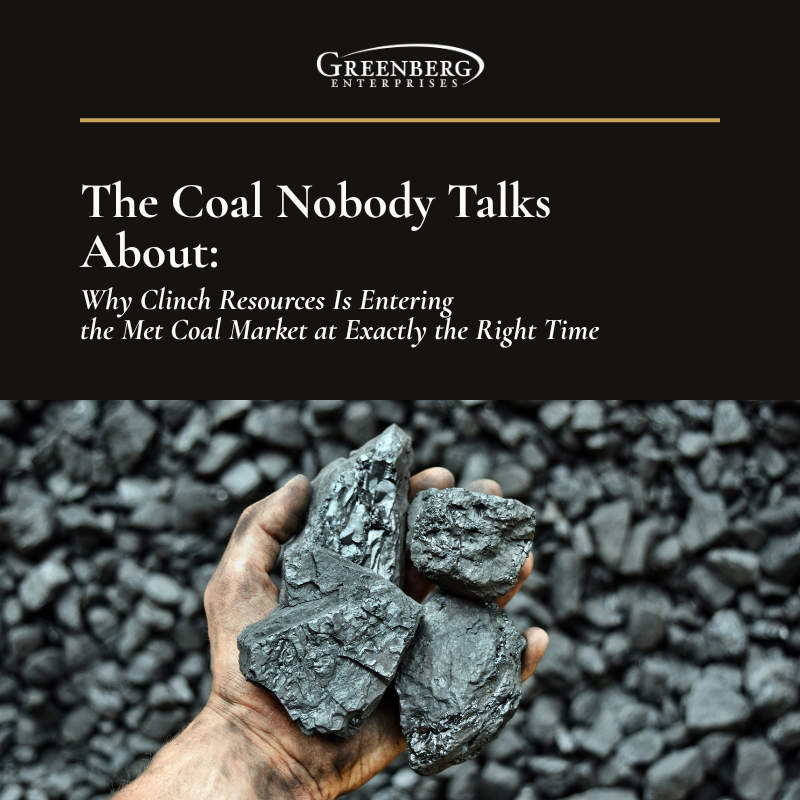
The Coal Nobody Talks About: Why Clinch Resources Is Entering the Met Coal Market at Exactly the Right Time
There are two kinds of coal, and most people only know about one of them.
Thermal coal heats homes and powers grids. It's the coal politicians argue about and environmentalists target. It's also genuinely in structural decline in most developed markets.
Metallurgical coal is different. It's the coal that makes steel. It's an input, not a fuel, and there is no commercial-scale substitute for it in the blast furnace steelmaking process that produces roughly 70% of the world's steel today. When a bridge gets built, a skyscraper goes up, or a ship gets assembled, metallurgical coal was part of making that steel possible.
That distinction matters enormously when evaluating Clinch Resources (TSX: CLCH), a new Knoxville, Tennessee-based producer that listed on the Toronto Stock Exchange in March 2026 and is now ramping toward production from its West Virginia assets. Because the history of companies that failed to make this work, and the structural reasons Clinch's setup looks different, are both worth understanding clearly before drawing any conclusions.
Why Met Coal Companies Have Had a Hard Time
The met coal sector has a bruising recent history, and it's worth being honest about it rather than glossing over it.
Between 2012 and 2017, nearly every major U.S. coal company filed for bankruptcy protection. Alpha Natural Resources, Arch Coal, Peabody Energy, Walter Energy, and Patriot Coal all went through Chapter 11. At their 2011 peak, the four largest U.S. miners by output were worth a combined $34 billion. By 2016, that figure had collapsed to approximately $150 million.
The cause was not mysterious. All of them made the same mistake at the same time: they borrowed enormous sums to acquire met coal assets at the peak of the cycle in 2011, betting that Chinese steel demand would keep growing indefinitely. Alpha Natural Resources paid $7.1 billion for Massey Energy. Arch Coal paid $3.4 billion for International Coal Group. Walter Energy paid $3.3 billion for Western Coal in Canada. When Chinese steel demand softened and prices fell from $330 per ton in early 2011 to $93 per ton by mid-2015, the debt loads became impossible to service.
The lesson that history teaches is clear: it wasn't the coal that failed. It was the debt, the timing of acquisitions, and the concentration of bet on a single demand driver at the top of the market.
Clinch Resources is not walking into this market the same way those companies did. It listed on the TSX via a reverse takeover in March 2026 with a $46 million concurrent financing and no significant debt on its balance sheet. Its management has framed the company explicitly as "shovel-ready, fresh cash, no debt, and a clean balance sheet." That starting position is categorically different from what defined the class of 2011 acquisitions.
What Clinch Actually Has
The company's primary asset is the ARI project in southern West Virginia, which holds an estimated measured and indicated mineral resource of approximately 111 million tons of metallurgical coal across 54,000 acres, with approximately 64 million tons in the measured category and 47 million in the indicated category. The geological continuity is described as well-established through an extensive historical drill program.
Its second asset, acquired through a 38.8% indirect stake in JJ Resources Inc. as part of the March 2026 RTO, is the Sewell Mountain mine: a fully permitted, 24,000-acre mid-volatility met coal operation in West Virginia.
Both assets are in Appalachia, the historically dominant region for U.S. metallurgical coal production. Both are fully permitted. The ARI project has an existing wash plant and rail load-out infrastructure already in place, meaning Clinch doesn't need to build processing and transport infrastructure from scratch, which is one of the biggest capital and time sinks facing new met coal entrants.
On cost positioning: independent analyst research and the company's own disclosures cite estimated life-of-mine cash costs of approximately $90 per ton, which places the assets in the lower quartile of the global met coal cost curve. An analyst report from Ocean Wall published in March 2026 called the asset positioning "highly compelling," noting the Sewell Seam yields low-ash, low-sulfur, mid-volatility coal qualifying for both blast furnace and specialty steel markets.
The Production Timeline
Clinch has published specific near-term milestones and has already begun executing against them. Initial coal production from the Lanes Branch surface mine at ARI was targeted for late Q2 2026. On May 26, 2026, the company announced delivery of its first Caterpillar HW 300 Highwall Miner to the Lanes Branch operation, with a second unit scheduled for delivery in the following months. Each unit is targeted to produce approximately 180,000 clean tons of met coal per year once fully operational, at a cash cost of less than $60 per clean ton.
First coal production from the underground Mine 8 is targeted for late Q2 or early Q3 2026. Construction of a new wash plant, load-out, slope, and shaft at JJ Resources is targeted for completion in 2027. Management has communicated a production ramp toward approximately 2 million tons annually within 12 to 18 months, with life-of-mine cash costs of approximately $90 per ton. Against current met coal forwards of approximately $225 per metric ton, management is targeting hundreds of millions in EBITDA at scale.
It is important to note: those EBITDA projections are forward-looking management targets, not audited results. The company is pre-cash flow as of the date of this post. The milestones above are stated targets, not completed achievements. The delivery of the first highwall miner is a confirmed execution step, not a production figure.
The Market Clinch Is Entering
This is where the structural backdrop becomes relevant, and where the context of the failed companies of the 2010s matters most.
The companies that went bankrupt in 2012 to 2017 failed not because met coal demand collapsed but because they overpaid for assets, carried too much debt, and were caught in a severe price downcycle while over-leveraged. The underlying demand for met coal has never permanently disappeared.
In November 2025, metallurgical coal was added to the U.S. Department of the Interior's 2025 Critical Minerals List, a formal designation confirming that the government views it as vital to U.S. economic and national security, with supply chains that are vulnerable to disruption. The final list, published November 7, 2025 through the U.S. Geological Survey, added metallurgical coal as one of 10 new minerals to the existing 50, bringing the total to 60 critical minerals. This designation has practical consequences: it opens the door to expedited permitting, potential federal investment support, and tax credit eligibility considerations currently being evaluated in Congress.
On the supply side, BHP's published economic and commodity outlook from August 2025 cites Wood Mackenzie data estimating that approximately 250 million tons of operating seaborne met coal supply capacity is expected to deplete between 2025 and 2035, with only a handful of new mines confirmed before 2030. The replacement pipeline is, by most credible accounts, thin relative to that depletion rate.
The "50 million metric ton undersupply by 2028" figure cited in Clinch's investor materials and the RedChip interview with CFO Brett Young has not been independently verified through a third-party publicly linked source. It may derive from proprietary research not publicly available. Readers evaluating that specific number should treat it as a management projection rather than an independently confirmed market figure.
What is independently confirmed is the BHP and Wood Mackenzie framing: significant depletion of existing seaborne supply is coming, new mine development has been constrained by regulation, financing access, and permitting timelines, and India in particular is expected to be a growing source of met coal demand as it expands its steel production capacity.
The Honest Comparison
The met coal companies that failed in the 2010s shared three characteristics: they acquired assets at peak cycle pricing, they financed those acquisitions with large debt loads, and they were structurally exposed to a single demand driver, Chinese steel production, that decelerated without warning.
Clinch Resources is entering the market with fully permitted, past-producing assets it acquired at a fraction of what those companies paid per ton at the 2011 peak, with no significant debt, in a regulatory environment that has explicitly classified the commodity as strategically critical, and against a supply backdrop where 250 million tons of existing seaborne capacity is projected to deplete over the next decade.
That doesn't make the thesis guaranteed. Met coal prices are cyclical and have been under pressure through 2025 due to weak Chinese steel demand and elevated exports from that market. The production ramp still needs to execute on schedule. The EBITDA targets are management projections, not contracted revenue.
But the structural setup that destroyed the class of 2011 was one of excess leverage, peak-cycle acquisition prices, and a single-point demand dependency. Clinch's setup, on each of those three axes, looks materially different.
What This Story Fits Into
We've written about helium, tungsten, copper, HALEU and domestic manufacturing. The consistent thread is the same: a material that was once taken for granted as reliably available becomes a supply chain story when the depletion math meets constrained new development. Met coal is that story in the steel sector. The blast furnaces are running. The depletion clock on existing seaborne supply is ticking. The companies with low-cost, fully permitted, production-ready assets in stable jurisdictions are the ones positioned to matter when that gap opens.
Clinch Resources may be a small company by the standards of Warrior Met Coal or Alpha Metallurgical Resources. But it's entering the market with assets that check the boxes that historically mattered, and without the balance sheet that historically killed the companies that came before it.
Sources
- "Clinch Resources Ltd. Announces Listing on Toronto Stock Exchange," Clinch Resources Ltd. press release, March 20, 2026. https://finance.yahoo.com/markets/stocks/articles/clinch-resources-ltd-announces-listing-113000059.html
- "Clinch Resources Makes Its Move Into the Met Coal Market," Globe and Mail / B-TV, June 2026. https://www.b-tv.com/articles/clinch-resources-makes-its-move-into-the-met-coal-market-btv
- "Clinch Resources Acquires First Caterpillar Highwall Miner for West Virginia Met Coal Operation," Proactive Investors, May 26, 2026. https://www.proactiveinvestors.com/companies/news/1092895/clinch-resources-acquires-first-caterpillar-highwall-miner-for-west-virginia-met-coal-operation-1092895.html
- RedChip Fact Sheet, Clinch Resources Ltd. (TSX: CLCH). https://www.redchip.com/assets/reports/CLCH_FactSheet.pdf
- Ocean Wall Research, cited in: "Mining Co. Begins High-Quality West Virginia Met Coal Operations," Streetwise Reports, May 29, 2026. https://www.streetwisereports.com/article/2026/05/28/mining-co-begins-high-quality-west-virginia-met-coal-operations.html
- "Interior Department Releases Final 2025 List of Critical Minerals," U.S. Geological Survey, November 6, 2025. https://www.usgs.gov/news/science-snippet/interior-department-releases-final-2025-list-critical-minerals
- "Final 2025 List of Critical Minerals," Federal Register, November 7, 2025. https://www.federalregister.gov/documents/2025/11/07/2025-19813/final-2025-list-of-critical-minerals
- BHP Economic and Commodity Outlook, August 2025 (citing Wood Mackenzie: approximately 250Mt of operating seaborne supply expected to deplete 2025 to 2035). https://www.bhp.com/investor-hub/reports-and-presentations/economic-and-commodity-outlook/2025/08/economic-and-commodity-outlook
- "How Alpha Natural Resources Came to the Brink of Bankruptcy," Market Realist, July 2015 (historical context on 2011 acquisitions and price collapse). https://marketrealist.com/2015/07/alpha-natural-resources-came-brink-bankruptcy/
- "The Hidden Cause of America's Coal Collapse," Rhodium Group, February 2016 (combined market cap collapse from $34 billion to $150 million). https://rhg.com/research/the-hidden-cause-of-americas-coal-collapse/
- RedChip / X post, CFO Brett Young interview figures (management projections: ~$90/ton cash cost, ~2 million ton production target, ~$225/ton met coal forwards, 50Mt undersupply projection attributed to management). https://x.com/RedChip/status/2071984766291718569
Disclosure: This post discusses a publicly traded company (TSX: CLCH). Nothing in this article constitutes investment advice. All figures are sourced and linked above. Where a figure originates from company or management communications rather than an independent third-party source, that has been stated explicitly.
Related